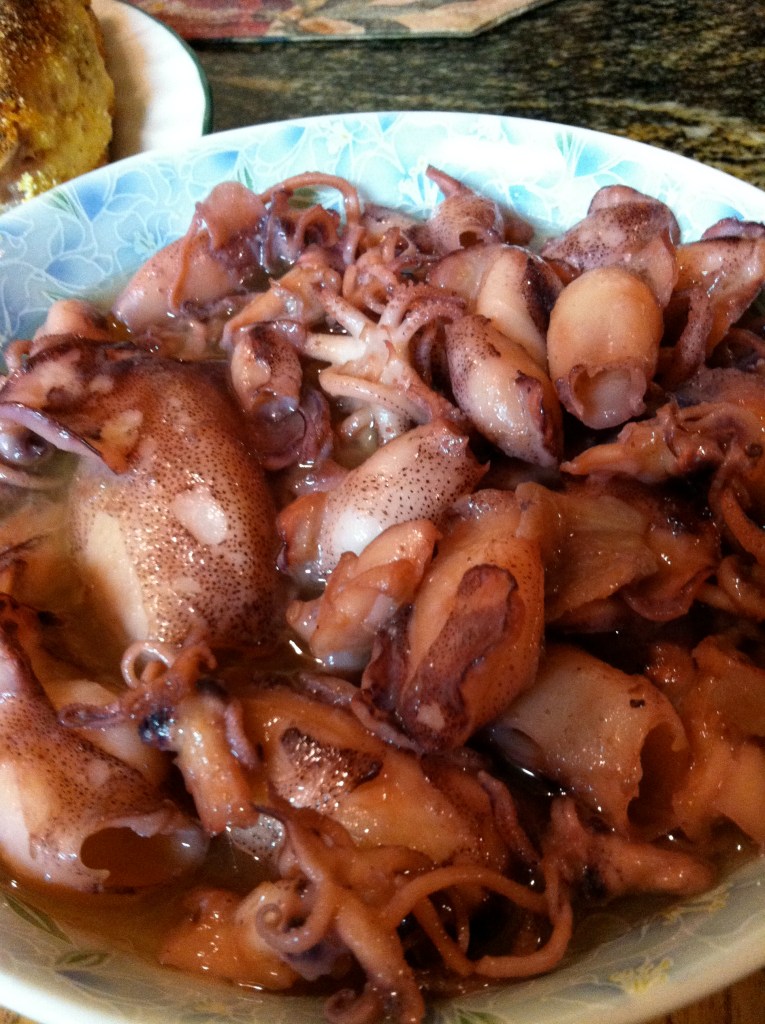
Fresh squids are not usually sold as food here around the Galveston Bay because they are small. They are sold as fish baits. Super Markets and the seafood markets sometimes sell frozen squids in boxes that are imported and they are usually large and uniform in size. I buy them sometimes if I crave for seafood but these tiny ones are a lot better because they are more tender and fresher.
I bought these tiny baby squids at the bait shop that also sells red snappers and flounders. They do not have a big store or big selection of seafood but this outfit has many boats and they supply oysters and seafood to a lot of other seafood retailers and restaurants. I am sure everything they sell, especially shrimp is fresh, as fresh as you can get it.
The above dish is one pound of squid. It took a while to clean and gut these tiny squids. I must really like them a lot to be patient cleaning them one at a time and some were smaller than my pinky and they will shrink considerably when cooked.
After rinsing them and draining most of the water, clean each one by doing these in sequence:
- Spread the tentacles at the head and find the hard beak. Secure the head part with one hand, dig and pinch the beak with the other hand then pull it leaving the head and tentacles intact. Use the fingernails to pinch if necessary.
- At the pointed side of the body opening, look for the cartilaginous endoskeleton that looks like a long, stiff transparent cellophane and pinch it with the fingernails and pull it out.
- Carefully pull the head part from the body and try to get as much of the organs inside the body cavity especially the fatty transparent sacs that are way down at the bottom. Stick your finger in and scrape them out. Clean where it was attached at about the belly on the head part. Keep the head with tentacles and the body. Make sure there is nothing left inside the body. Sometimes you’d find a fish in there in the process of getting digested.
- Rinse and drain in a strainer.
- Continue to do the same until all are cleaned.
The ink sac is located just at the body opening, attached to the internal organs. Filipinos like to save this ink sac to make the gravy dark or almost black. The dish is judged as to how black the gravy is. The blacker it is, the better. And I think it is also a way to judge how fresh the squids are. But the ink sacs are definitely discarded here in the U.S. In fact they tell you to wash them off the squid if you find a recipe with instructions on how to clean them. The heads and tentacles are also often discarded and the body skinned and cut in rings. The squids are battered and fried as in Calamari.
No matter how I tried to save these ink sacs and include them in cooking the dish, I have not attained a very dark or blue-black gravy and I am beginning to think I may be doing something wrong. But then, I wonder if there is a difference between the squids from the Atlantic or The Gulf of Mexico and squids from the Pacific? I know shrimp are different and so are oysters. Oysters are darker and have stronger flavor coming from the Pacific, like they have more iodine than from the Atlantic or the Gulf. I suppose it doesn’t matter.
Ingredients:
- 1 lb. cleaned squid
- 2 cloves garlic, crushed and minced
- ¼ cup vinegar
- 1/2 tsp. salt
- 1 TBS Oil
In a small pot, heat 1 TBS cooking oil and sauté the garlic only until fragrant but not browned. Drop in the squid and sauté a few minutes. They will produce some liquid. Simmer for a couple of minutes or so, then take the squid out with a slotted spoon leaving the juice in the pot.
Add the vinegar. Simmer for a few minutes without stirring. Simmer until most of the liquid has evaporated. Add the squid back and add the salt. Stir ocassionally until hot.
Eat it with a lot of rice.
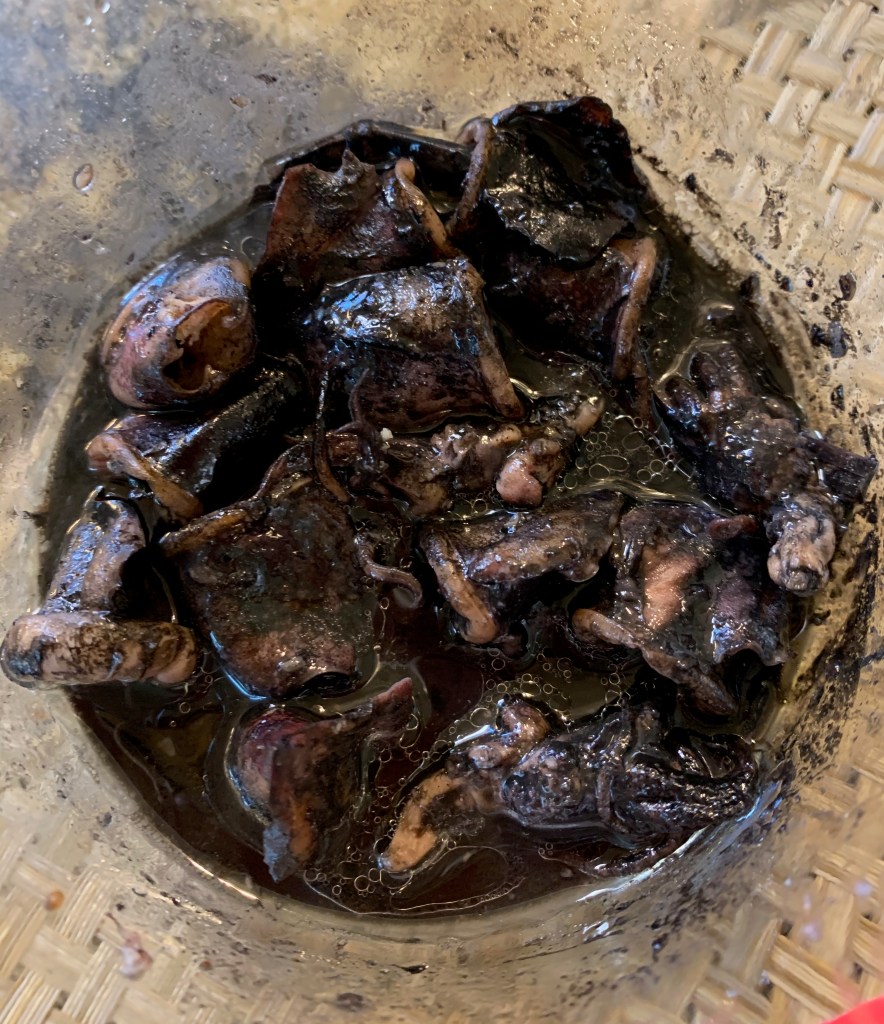
I discovered that there is a product imported from Spain called Cuttlefish Ink. I bought some and this is what adobong pusit should look like and it tastes better.
 Kusina ni Norie
You must be logged in to post a comment.