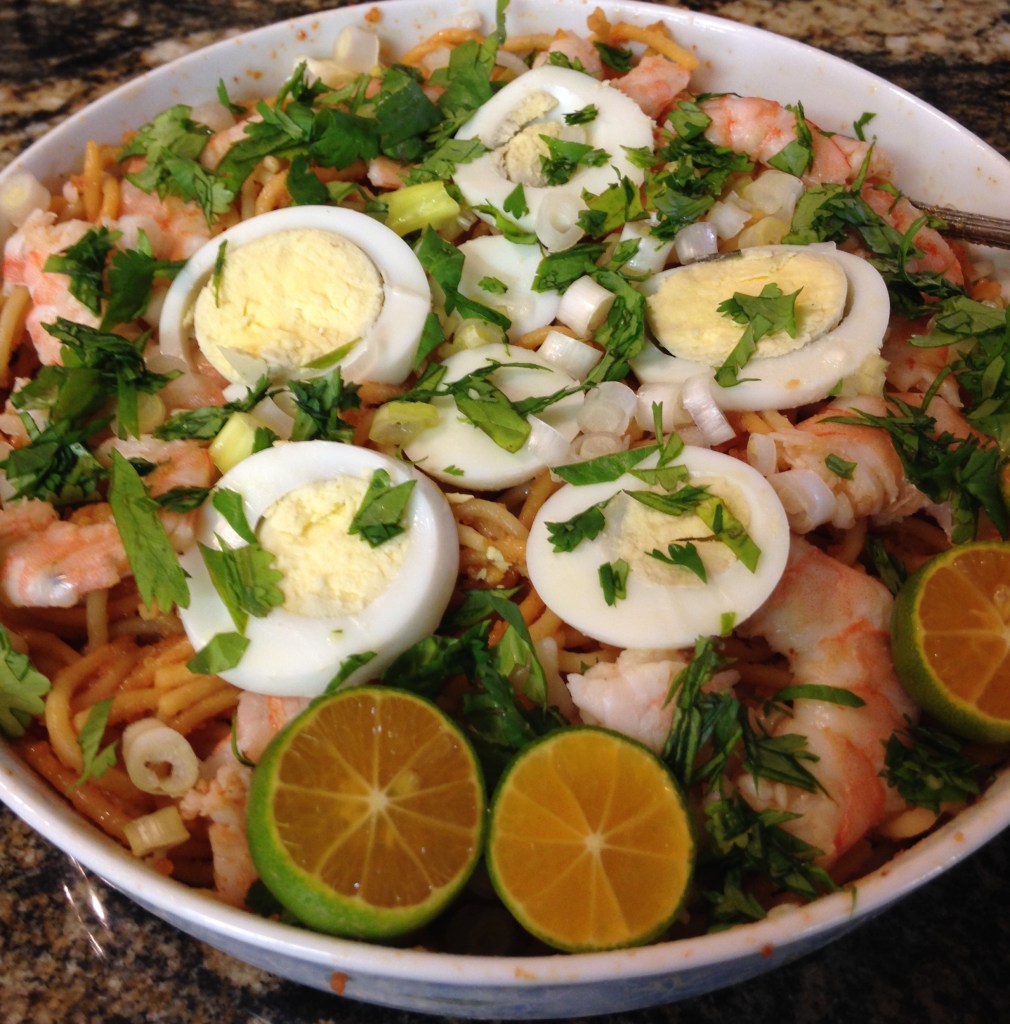
There are different kinds of Pancit but we will talk about each one separately as I make them.
Pancit Malabon was a specialty noodle dish in the town of Malabon, now part of Metro Manila.
The authentic Pancit Malabon is garnished on top with:
- Shrimp
- Flaked smoked fish
- Cooked squid
- Boiled eggs
- Steamed oysters
- Ground or crushed chicharrones
- A couple slices of calamansi and drizzled with patis
The smell of the smoked fish is too strong for the Americans and my husband would not eat it that’s why it is omitted here. The seafood ingredients for garnishing are also a bit too much for the American palate.
This is definitely a Filipino-American version because the original recipe uses fresh rice noodles that are impossible to get here. So, it is improvised and successful at that. We use spaghetti noodles instead.
Surprisingly, this modified recipe is delicious and I can’t tell the difference from my sister’s or from what I remember from the original town it came from. This is the modified and simplified version. My husband, our family and some of our American friends invited for dinner love it. Nothing on it is offensive to any of them. But perhaps I will make it the authentic way someday.
- 1-cup pork cracklins’ (chicharrones with some fat attached), crushed fine. (Not the large airy chicharrones)
- 2 large cloves garlic crushed
- 1/2 medium onion minced
- 1 cube Knorr shrimp bouillon or a chicken bouillon cube
- 1 packet Sazon Goya achuete con culantro or
- 1 packet Goya con azafran (Sazon Goya brand) (optional but will be better with it)
- 8 oz. Spaghetti noodles, thin or Angel hair, but regular is okay
- 1/4 c cooking oil
Note: If you do not have the Sazon Goya seasoning packets, use the regular achuete seeds or powder.
Procedure:
Break spaghetti noodles in thirds and cook according to package but cook them beyond “al dente”. I like them cooked softer and very light in color. Add 1 tsp. of salt in the water. You may cook the 2 eggs with it too. Drain well and set aside in a large pan.
Put the cracklings in a strong plastic bag and pound them with a meat mallet or garlic rock if you have one, to crush. Pound repeatedly and turn over until crushed fine. Or you can use a food processor. Set aside.
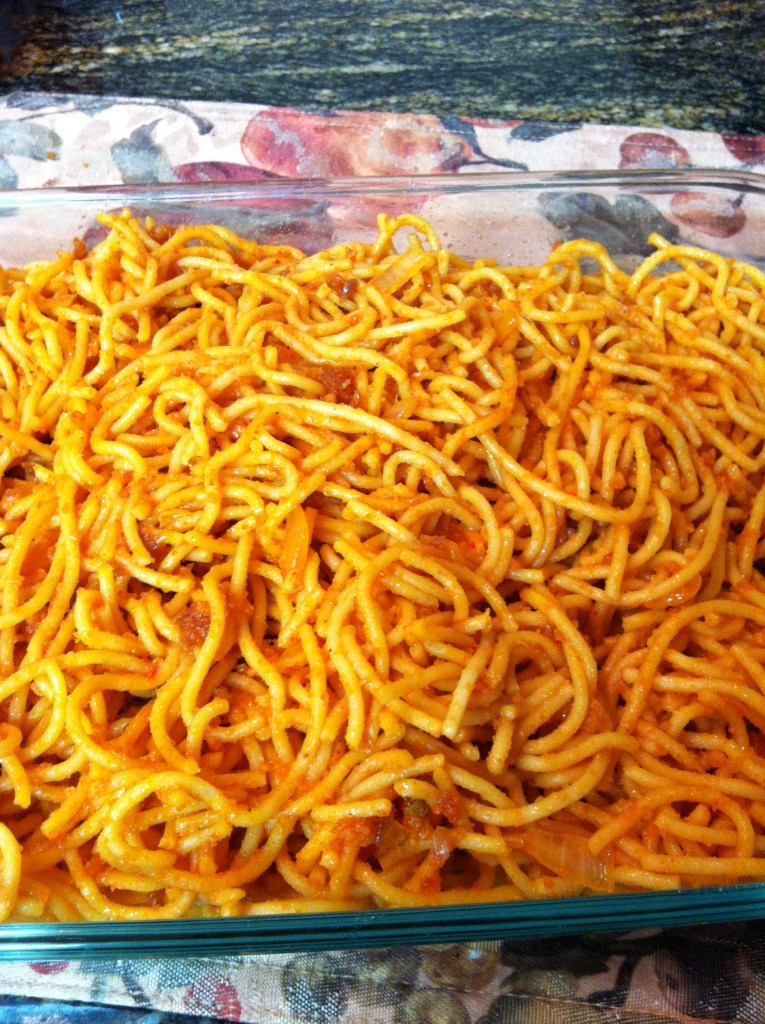
Sauté the garlic in ¼ c cooking oil until golden brown. Stir in the onion and sauté until soft. Add the shrimp or chicken bouillon and crush and stir in the oil until dissolved. Add the packet of Sazon Goya seasoning then add the crushed pork crackling or chicharrones and stir for a second or two then add this to the cooked spaghetti and blend well, use your fingers if necessary. If it is too wet and sticking together it needs to be drier. Add a small amount of breadcrumbs and mix well again. The noodles need to be separating, not sticking together.
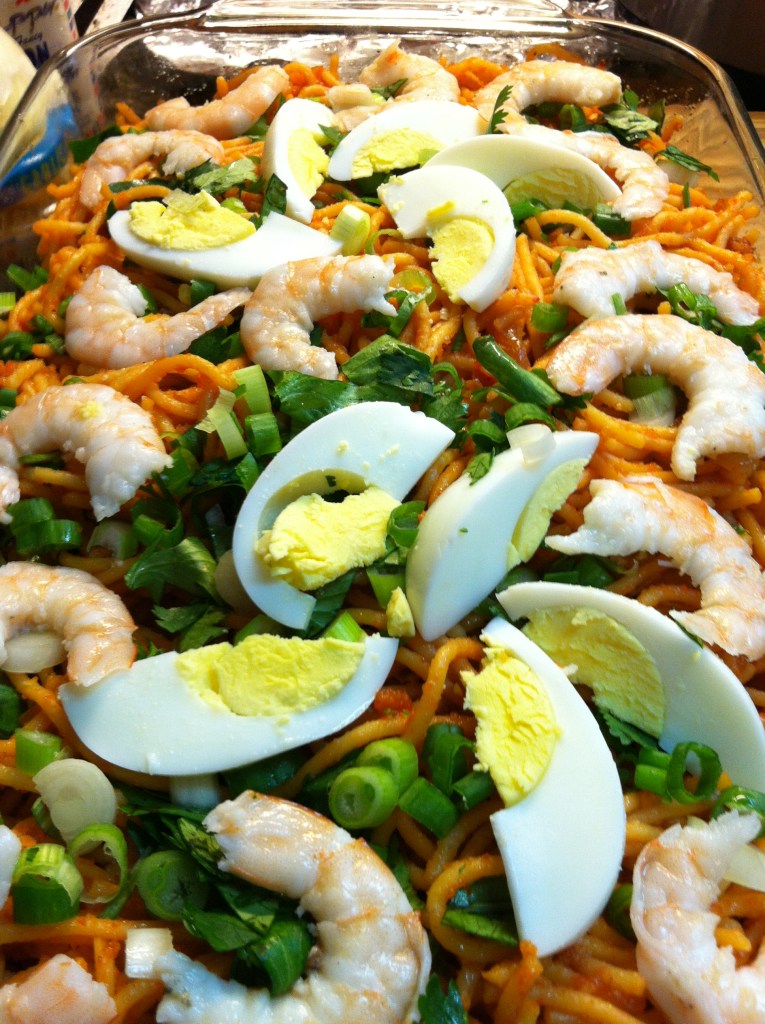
Arrange the garnishes on top like the picture above or be more creative.
Garnish:
- 1 or 2 green onions cut in small rings (include all except the roots)
- 1 hard-boiled egg sliced in eights lengthwise or crosswise thinly
- Fried garlic (bought or made) (optional)
- A few boiled shrimp peeled and sliced lengthwise
- A few steamed oysters or canned oysters if desired
- Cooked calamari can be used for garnish also.
- A few cilantro leaves, whole or chopped
- Lemon wedges or sliced calamansi (preferred)
Sprinkle more ground or crushed chicharrones (pork crackling) on the top. Shredded smoked fish is available at the Asian store; use it if desired.
Good accompaniment is fried Tofu with garlic and vinegar or the rest of the crackling dipped in crushed garlic and vinegar with a pinch of salt and a drop of Tabasco if desired. Eat with rice too.
I learned how to make this from my sister Winnie when she came to visit me. But she told me not to give the recipe away because it is a trade secret of her husband’s grandmother. But I noticed the snickering grin on my brother-in-law’s face when she said that. Whether I was gullible or not, I did not share it and had a tough time declining some Filipino friends’ requests to give them the recipe for a long time until I modified it.
When I was growing up back home, my mother would send a maid (or sometimes me) to order this Pancit in Malabon. Malabon is just the next town or two north of us and she had to ride a Jeepney, a public transportation to get there and back. She stayed there and waited until it was cooked but only if it was just a small order. If it was a very large order for a large company and if she could not wait there until it was cooked then she would go home or do a little shopping at the market there then go back to the panciteria to pick it up when it was ready. I guess it could be delivered if the vendor agreed.
From what I remembered, these small panciterias had a small space for a table or two with benches so some people could eat there too.
It came in a bilao (bih-la-o) lined and covered with banana leaves, like a tray if the order is big. A small order would just be carefully wrapped in a coned banana leaf then wrapped in a piece of newspaper or a paper sack.
You may wonder why we had to send somebody to order and not just call and have it delivered. Very few people had a telephone at the time especially not the poor vendors who only operated in their homes with a small storefront if any and only cooked it to fill an order.
Many people applied for telephone service but the phone company was too slow in installing cables for residential customers. As an example, my parents applied for a phone service almost right after WWII at about when I was born but didn’t get it installed until after I had my first baby. I was hoping that I could make a call if I needed to when I started labor but it didn’t happen that way. Maybe I could use the phone when I have my next baby. Huh!
The authentic noodles used in pancit Malabon are fresh and fat rice noodles. There is a similar pancit as Pancit Malabon called Pancit Luglog. It also uses the same fat rice noodles. The fresh rice noodles are placed in a small bamboo sieve or strainer that looks like a small basket with a long bamboo handle. The noodles in the basket is steeped in a pot of boiling water for a few minutes or seconds and then lifted and shook and jerked up and down to drain, thus named luglog, which translates to dip, drench or soak repeatedly. The cooked noodles are transferred to a bamboo plate (bilao) lined with banana leaves. The sauce is then poured over the noodles then garnished with the same garnishing as the Pancit Malabon. Oil is drizzled on the noodles to prevent the noodles from sticking together. It is very similar to Pancit Malabon except it is saucier or moistier and as far as I remember, not as red. Pancit Luglog was sold and made in my town and as a matter of fact it was sold at a “panciteria” directly across the street from our house.
There is yet another similar pancit as Pancit Luglog called Pancit Palabok. It is a lot saucier as the noodles are drenched in the sauce or gravy but it may or may not have any garnish, except maybe chopped green onions, cilantro and fried garlic and sometimes sliced hard boiled eggs and roughly ground chicharrones or cracklins’ . The noodles used in pancit palabok are the fine rice noodles used in pancit bihon.
However, all the above pancits have a very strong shrimp flavor. The stock from shrimp heads and shells is the base in cooking them.
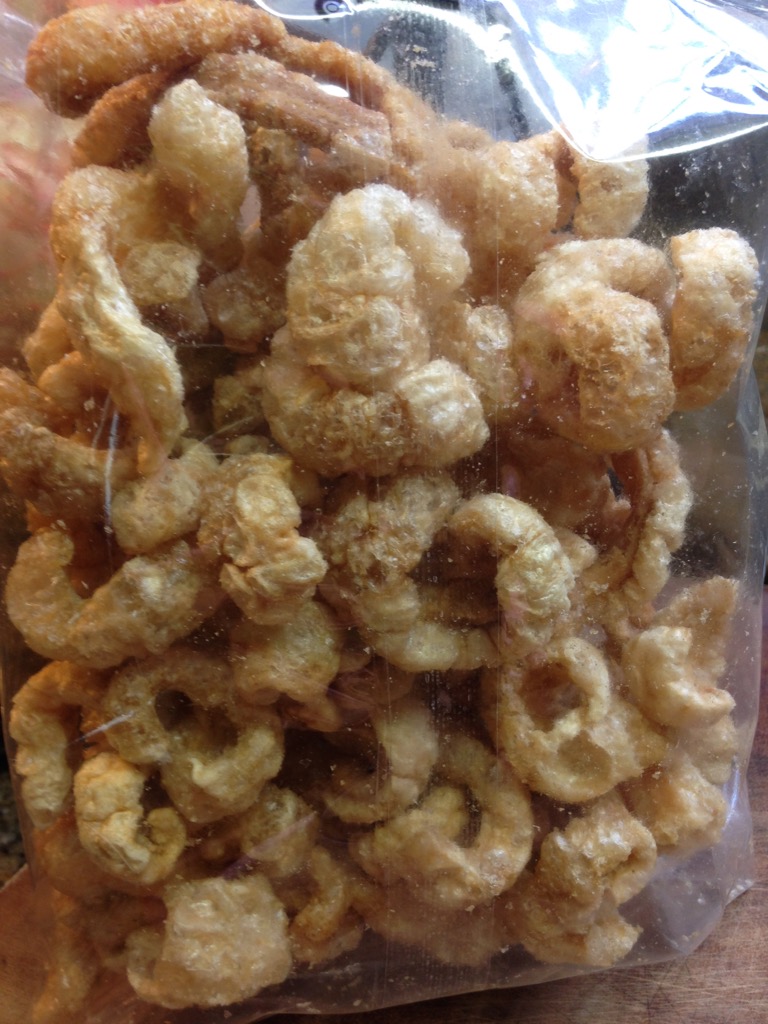
This is a package of the chicharrones or cracklins’ I used in the recipe. They are now available at most American grocery stores in the salty snack section with the chips.
 Kusina ni Norie
You must be logged in to post a comment.